
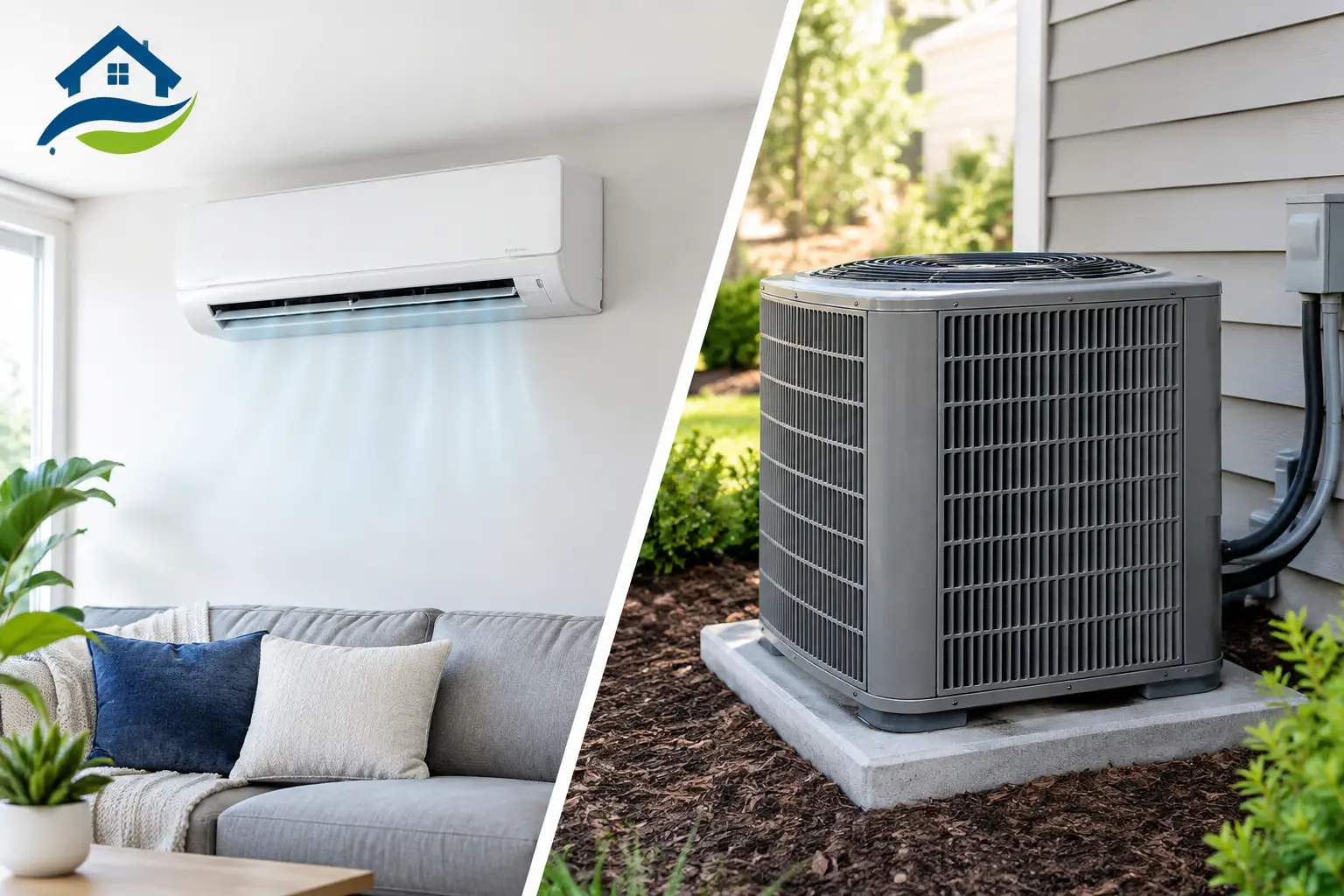
A hot upstairs bedroom, an aging furnace, or a room addition that never cools properly can turn ductless versus central air into an urgent homeowner decision. Both systems can deliver dependable cooling and heating in Los Angeles County, but they solve different problems. The right choice depends on your home's layout, existing infrastructure, comfort priorities, and plans for the property.
Ductless Versus Central Air: The Basic Difference
Central HVAC uses one outdoor condenser or heat pump connected to an indoor air handler or furnace. Conditioned air travels through a network of ducts and reaches each room through supply registers. A thermostat typically controls the system for the whole home, though zoning equipment can divide the house into separate areas.
A ductless mini-split system uses an outdoor unit connected to one or more wall-mounted, ceiling-mounted, or concealed indoor units. Each indoor unit serves a specific room or zone and has its own temperature control. Instead of large duct runs, installers route compact refrigerant lines, electrical wiring, and a condensate drain between the indoor and outdoor equipment.
Neither approach is automatically better. A well-designed central system can provide quiet, balanced whole-home comfort. A properly sized ductless system can give individual rooms remarkable control while avoiding the expense and disruption of installing new ductwork.
When Central Air Makes the Most Sense
Central air is often the practical choice for a Los Angeles home that already has usable ductwork. This is common in houses with an existing furnace, attic ducts, or a prior central air system that needs replacement. If the duct system is appropriately sized, sealed, insulated, and in good condition, a new high-efficiency central air conditioner or heat pump can upgrade comfort without changing the home's appearance room by room.
For homeowners who prefer a discreet look, central equipment has a clear advantage. Supply registers are relatively unobtrusive, while the major mechanical components stay in the attic, closet, garage, crawlspace, or outside. Central systems also work well when the goal is consistent circulation throughout an entire home rather than separate temperature preferences in each room.
Central HVAC can also better support whole-home air-quality equipment. Depending on the design, that may include upgraded filtration, ventilation, humidification, or air-cleaning components installed at the central air handler. This does not mean ductless systems cannot improve indoor air quality, but a ducted system offers a single pathway for treating air across the house.
The condition of the ducts matters
Existing ducts should not be assumed to be an asset simply because they are present. Older Los Angeles homes can have leaky, poorly insulated, undersized, disconnected, or contaminated ductwork. A new condenser attached to failing ducts may still leave rooms uncomfortable and energy bills higher than expected.
Before recommending central replacement, a qualified contractor should evaluate the duct layout, return-air path, insulation, equipment size, and airflow. Duct repairs or replacement may be part of the correct scope of work. That adds cost upfront, but it protects the performance of the new HVAC equipment for years to come.
When a Ductless System Is the Better Fit
Ductless mini-splits are especially useful where ducts do not exist or where extending them would be difficult. An older bungalow, converted garage, detached workspace, ADU, room addition, sunroom, or finished attic may be an excellent candidate. Rather than opening substantial sections of walls and ceilings to run ducts, the installation can often be completed with limited disruption.
They are also a strong option for homes with uneven temperatures. If one side of the home overheats in the afternoon or a second-floor bedroom stays warm after the central system has cooled the rest of the house, a ductless zone can address that specific area. The homeowner can cool an occupied room without conditioning every unused room at the same level.
Because each indoor unit has independent control, ductless systems make sense for households with different comfort preferences. One family member can keep a bedroom cooler at night while another zone remains at a more moderate setting. This room-by-room control can reduce unnecessary energy use when the system is designed and operated thoughtfully.
The trade-off is visibility. Wall-mounted heads are functional and modern, but they remain visible in the room. Ceiling cassettes and concealed ducted mini-split units can reduce that impact, although they may require more construction work and coordination. Placement must also allow for proper airflow, service access, drainage, and a clean installation.
Installation Cost Is About Scope, Not Equipment Alone
Homeowners often ask which is cheaper: ductless or central. The honest answer is that it depends on the number of rooms, condition of existing equipment, electrical needs, access to the work area, and whether ducts must be added or rebuilt.
Replacing a central system where sound ducts already exist can be more cost-effective than installing several ductless indoor units. On the other hand, a ductless solution may cost less than building an entire duct system through an older home with limited attic or crawlspace access. A single-zone unit for a bedroom or addition is usually a much smaller project than whole-home central HVAC.
Electrical capacity deserves attention, particularly when replacing gas heating with an all-electric heat pump. Some homes need panel upgrades, new circuits, or other electrical work before the installation can proceed safely. During remodels, additions, and ADU construction, planning HVAC early prevents costly changes later in the project.
Comfort, Efficiency, and Noise
Both central and ductless systems are available in efficient heat-pump configurations that provide cooling in summer and heating during Southern California's mild winter conditions. Actual efficiency depends on more than the equipment rating. Correct sizing, careful installation, insulation, windows, duct condition, thermostat settings, and maintenance all affect real-world results.
Ductless systems avoid energy losses from leaky ducts, which is a meaningful benefit in many older properties. Their variable-speed operation can also adjust output gradually instead of repeatedly cycling at full capacity. Central heat pumps can offer similar variable-speed performance, but they still rely on a sound duct distribution system.
Noise is another practical consideration. Quality ductless indoor units are typically quiet, while central systems keep most of their mechanical sound away from living areas. Poor installation can make either option noisier than it should be. Proper equipment location, secure mounting, correct refrigerant charging, and balanced airflow are workmanship details that homeowners notice every day.
Consider Your Long-Term Plans for the House
The best HVAC decision should support the way you plan to use the property. For a whole-home renovation, central air may be easier to integrate while walls and ceilings are open. New duct runs, returns, insulation, and mechanical closets can be planned cleanly as part of the construction scope.
For a phased improvement, ductless can provide immediate comfort in the rooms that need it most. A homeowner might install a multi-zone system for bedrooms now, then make a broader central HVAC decision during a future remodel. Hybrid approaches are also common: retain or replace central HVAC for the main house and add a ductless unit for an addition, ADU, converted garage, or difficult room.
Avoid choosing based on square footage alone. Two homes with the same footprint can have very different cooling needs because of ceiling height, sun exposure, window area, insulation, occupancy, and floor plan. Oversized equipment can short-cycle, waste energy, and leave indoor humidity less controlled. Undersized equipment may run constantly without reaching the desired temperature.
Start With a Home-Specific Assessment
A dependable recommendation begins with a walkthrough, not a guess. The assessment should consider the home's existing ducts, equipment age, room temperatures, insulation, electrical capacity, drainage requirements, and plans for renovations or additions. It should also identify whether a comfort complaint is truly an equipment problem or an airflow, duct, insulation, or building-envelope issue.
Alfa Home Services helps Los Angeles County homeowners evaluate HVAC choices with the full property in mind, including ductwork, electrical coordination, additions, and remodel-related construction needs. Clear scope, licensed work, and respect for the home matter just as much as the equipment selected.
The right system is the one that fits your home rather than forcing your home to fit the system. A careful evaluation now can lead to quieter rooms, more even temperatures, and a project that supports your property for the long term.